Short description
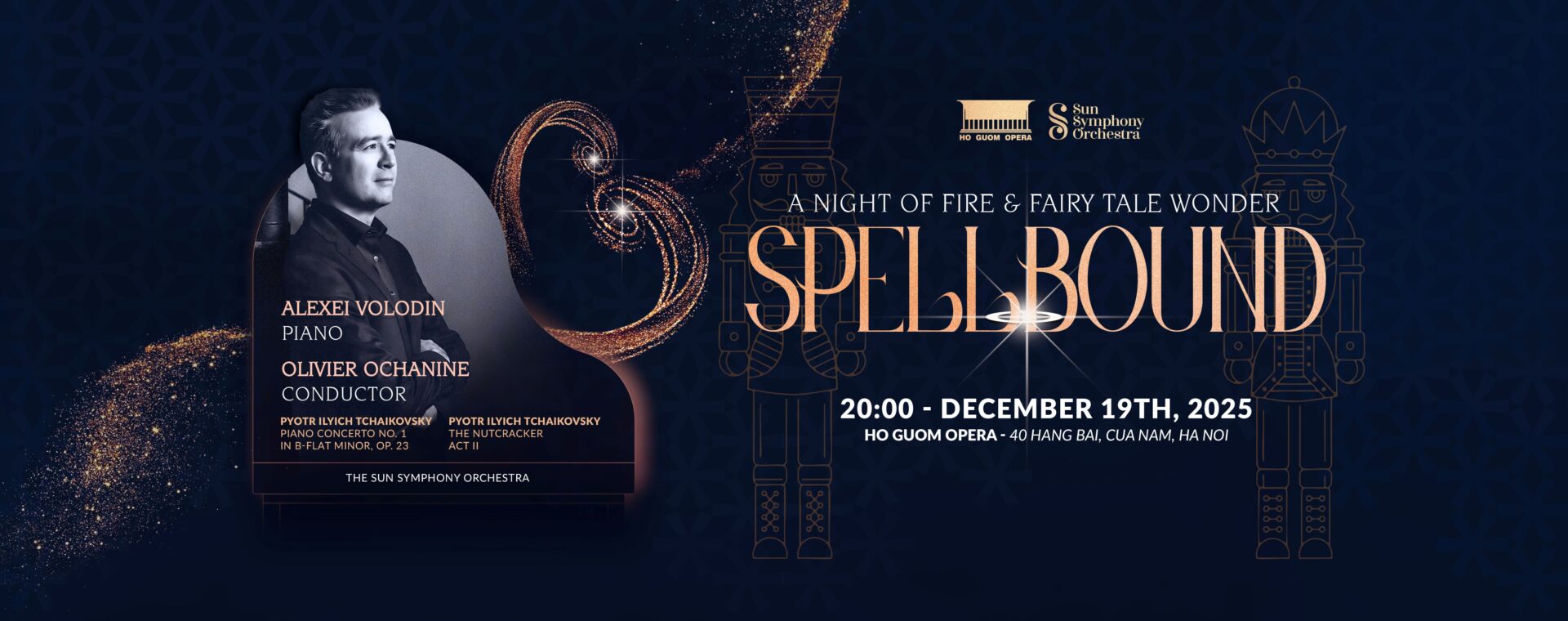
This Christmas, Music Director Olivier Ochanine will accompany audiences of all ages on a journey back to childhood and reunite with the brave Nutcracker in a world shimmering with magic? Spellbound: A Night of Fire & Fairy Tale Wonder is the very doorway into that realm of memories.
Pyotr Ilyich Tchaikovsky
Piano Concerto No. 1 in B-flat minor, Op. 23
Pianist Alexei Volodin
Pyotr Ilyich Tchaikovsky
The Nutcracker, Act II
Tchaikovsky Piano Concerto No. 1 & Act II of The Nutcracker
Sun Symphony Orchestra
Conductor: Olivier Ochanine
Piano: Alexei Volodin
⸻
Pyotr Ilyich Tchaikovsky
Piano Concerto No. 1 in B-flat minor, Op. 2
Few works in the piano repertoire announce themselves with such unshakeable authority as Tchaikovsky’s First Piano Concerto. From the first granitic chords in the orchestra — a proclamation as monumental as a cathedral façade — the concerto asserts a world of passion, struggle, and triumphant release. Yet even as the soloist hammers those chords in octaves, the famous opening melody is played exclusively by the orchestra. Tchaikovsky withholds the theme from the pianist entirely, a radical choice that adds to the sense of grandeur and theatrical tension.
Composed between November and December 1874, the concerto’s creation was surprisingly turbulent. Tchaikovsky dedicated the score to the virtuoso pianist Nikolai Rubinstein, expecting praise. Instead, Rubinstein delivered a scathing critique, calling it “vulgar” and “unplayable.” Devastated but unmoved, Tchaikovsky refused to change a single note. Vindication came swiftly: when the American pianist Hans von Bülow premiered the concerto in Boston in 1875, it was an immediate sensation. Today, it remains one of the most beloved and frequently performed concertos in the world.
The first movement unfolds with symphonic breadth — heroic, lyrical, and unafraid of grand gestures. Tchaikovsky’s gift for melody shines in every phrase, from the sweeping second theme to the glittering bravura passages for the soloist. The slow movement is a tender nocturne interrupted by a mischievous scherzo-like middle section, a moment of unexpected charm. The finale — a whirlwind inspired partly by Ukrainian folk melodies — bursts forth with rhythmic fire, driving the work to a triumphant, breathtaking conclusion.
Tonight, the concerto is brought to life by Alexei Volodin, one of the most compelling pianists of his generation. Known for his crystalline technique and poetic sensitivity, Volodin brings both the nobility and the ferocity of Tchaikovsky’s score into sharp focus.
(Intermission)
Pyotr Ilyich Tchaikovsky
The Nutcracker: Act II
Act II of The Nutcracker offers one of the most enchanting journeys in all of ballet — a seamless tapestry of musical colour, dancing imagery, and imaginative storytelling. Having defeated the Mouse King and traveled through the Land of Snow, Clara and her Nutcracker Prince arrive in the Land of Sweets, where they are welcomed by the Sugar Plum Fairy and treated to a dazzling sequence of dances from around the world.
Though the ballet’s premiere in 1892 received only a lukewarm reception, the music soon became cherished as some of Tchaikovsky’s most magical writing. The composer’s gift for orchestral colour is on full display: the airy sparkle of celesta in the Dance of the Sugar Plum Fairy (an instrument so new that Tchaikovsky practically “claimed” it for himself), the effervescence of the Russian Trepak, the sensual warmth of the Arabian Dance, and the elegance of the Waltz of the Flowers — one of the greatest waltzes in the symphonic repertoire.
Act II is not merely decorative; it is a masterclass in orchestration. Tchaikovsky captures the atmosphere with astonishing precision. Each dance is a miniature painting, with its own palette and character, each crafted with loving detail. The act culminates in the Grand Pas de Deux, one of the most emotionally expansive moments Tchaikovsky ever wrote — noble, romantic, and radiantly expressive.
Performed in full, Act II allows audiences to experience The Nutcracker as Tchaikovsky envisioned it: not just as ballet, but as a symphonic fantasy — a world where imagination, nostalgia, and sheer musical beauty merge.
Tonight’s performance restores the wonder and sweep of this beloved act, inviting listeners into the heart of Tchaikovsky’s winter dream.