Short description
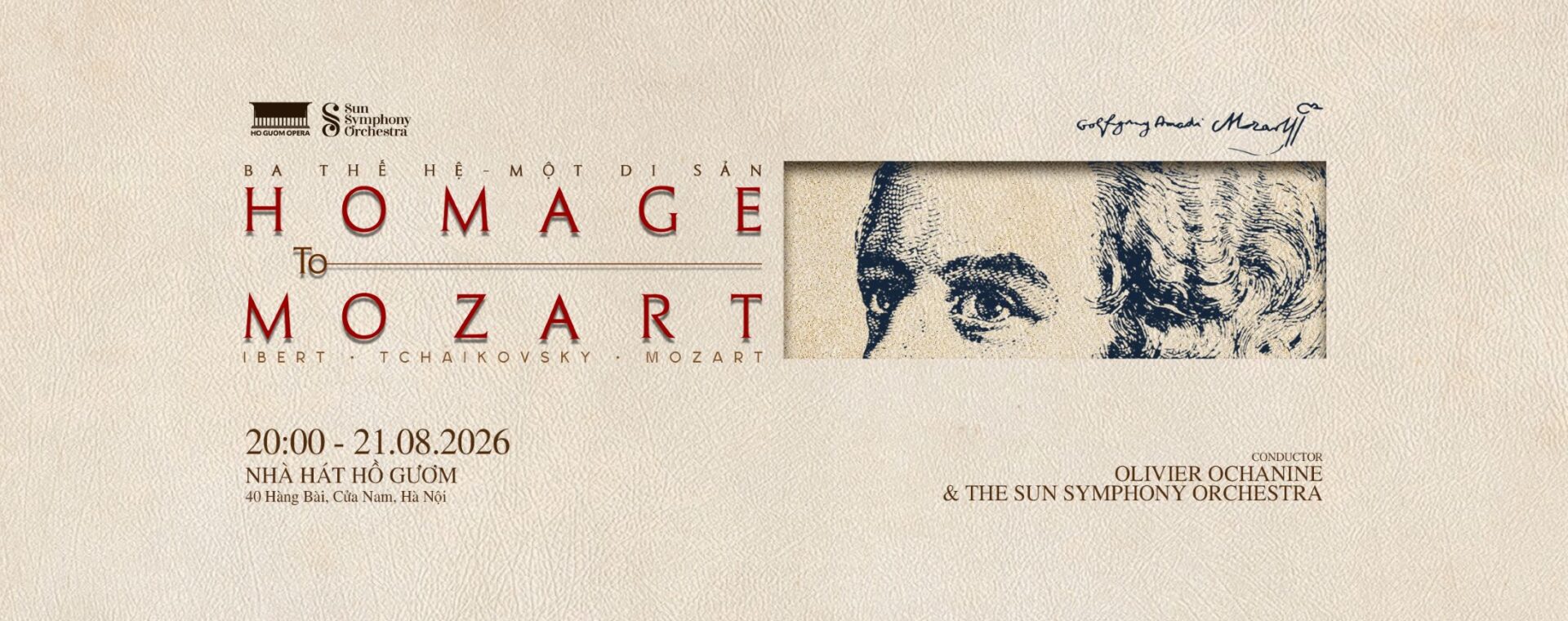
Wolfgang Amadeus Mozart từ lâu đã được xem là một trong những nhân vật vĩ đại nhất của âm nhạc phương Tây, được ngưỡng mộ không chỉ vì vẻ đẹp và sự tao nhã trong các tác phẩm của ông, mà còn vì sự cân bằng phi thường mà ông đạt được giữa trí tuệ và cảm xúc. Chương trình SSO tối nay tôn vinh di sản trường tồn đó thông qua ba góc nhìn âm nhạc khác nhau.
Jacques Ibert (1890–1962)
Hommage à Mozart
Pyotr Ilyich Tchaikovsky (1840–1893)
Suite No. 4 in G major, Op. 61, Mozartiana
-Intermission-
Wolfgang Amadeus Mozart (1756–1791)
Symphony No. 38 in D major, K. 504, Prague
Jacques Ibert (1890–1962)
Hommage à Mozart
Written in 1956 to commemorate the bicentenary of Mozart’s birth, Jacques Ibert’s Hommage à Mozart is a graceful salute from one of France’s most distinguished twentieth-century composers. Rather than attempting to imitate Mozart’s style, Ibert captures something of the spirit of the Classical master: elegance without affectation, wit without excess, and a sense of effortless musical conversation.
Although unmistakably modern in harmony and orchestral colour, the work embraces the principles of clarity, balance and refinement that lie at the heart of Mozart’s music. Transparent textures, lively rhythms and elegant melodic writing evoke the Classical world while remaining unmistakably Ibert’s own.
Compact, charming and brilliantly orchestrated, Hommage à Mozart serves as a delightful opening to tonight’s programme, demonstrating how Mozart’s artistic ideals continued to inspire composers two centuries after his death.
⸻
Pyotr Ilyich Tchaikovsky (1840–1893)
Suite No. 4 in G major, Op. 61, Mozartiana
No major composer revered Mozart more deeply than Tchaikovsky. He once described Mozart as “the musical Christ,” believing him to represent the highest expression of beauty in music. Composed in 1887, Mozartiana was written to commemorate the centenary of Mozart’s Don Giovanni and stands as one of the most heartfelt tributes ever paid by one composer to another.
Rather than composing an original work in Classical style, Tchaikovsky orchestrated four relatively unfamiliar piano pieces by Mozart. His approach is remarkable for its restraint. Instead of imposing the full weight of Romantic orchestration, he carefully preserves Mozart’s elegance while enriching the music with subtle orchestral colour and warmth.
The suite unfolds through four contrasting movements: a sparkling Gigue, a graceful Minuet, the deeply expressive Preghiera (“Prayer”), and a brilliant set of Variations that showcases both Mozart’s melodic invention and Tchaikovsky’s masterful orchestration. The result is not simply an arrangement, but a musical conversation across a century, revealing profound admiration from one genius to another.
⸻
Wolfgang Amadeus Mozart (1756–1791)
Symphony No. 38 in D major, K. 504, Prague
Mozart composed the Prague Symphony in 1786 during one of the happiest and most productive periods of his career. Following the tremendous success of The Marriage of Figaro in Prague, the city welcomed him with extraordinary enthusiasm, and the symphony has ever since been associated with the Czech capital where it received its first performance.
The work stands among Mozart’s greatest orchestral achievements. Its imposing slow introduction immediately signals a symphony of exceptional ambition, leading into an Allegro of remarkable vitality and contrapuntal sophistication. The lyrical Andante offers warmth and serenity before the exhilarating finale brings the work to a dazzling conclusion.
Unlike most Classical symphonies, the Prague contains only three movements, omitting the customary Minuet. This unusual structure lends the work a remarkable sense of focus and dramatic momentum. Rich in harmonic invention, formal mastery and expressive depth, the symphony represents Mozart at the height of his powers and remains one of the crowning achievements of the Classical repertoire.