Short description
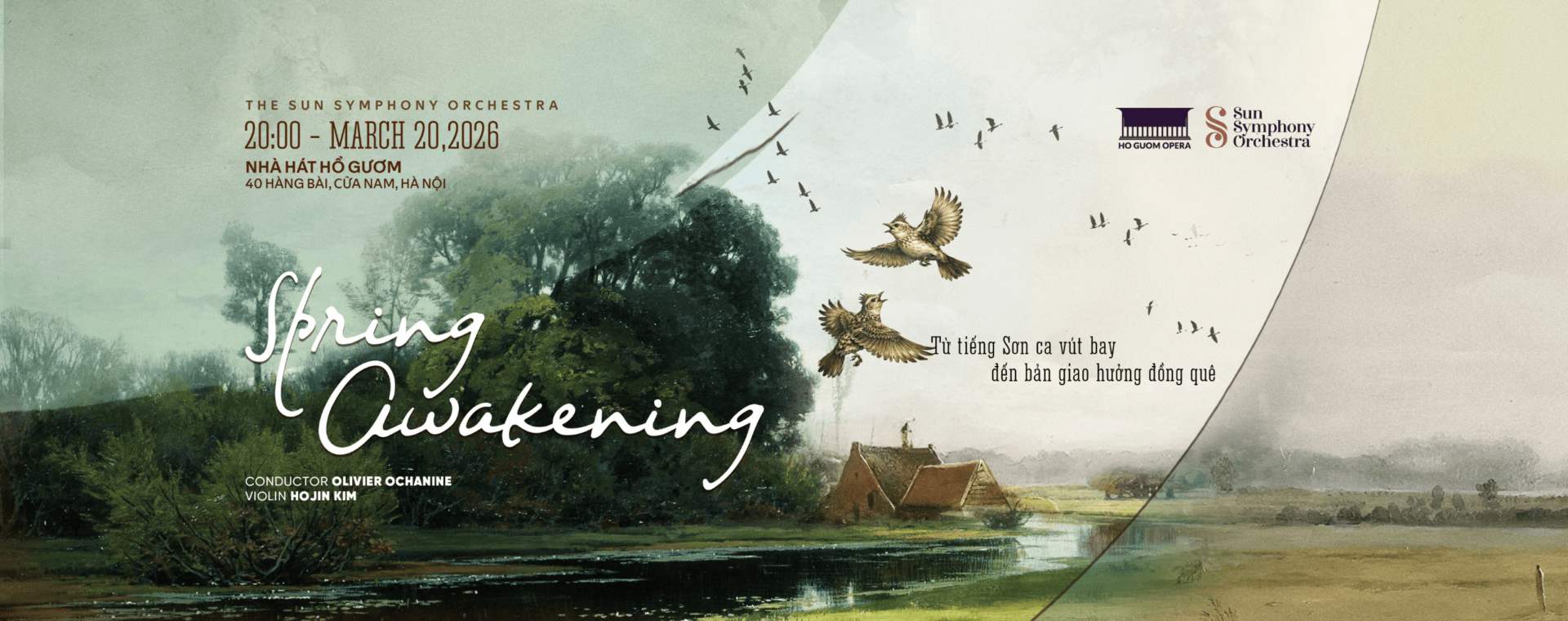
Spring is the season of leisurely living, and nothing is more elegant than letting the soul wander into the enchanting realms of music. On March 20, the SSO invites its musical confidants to return to the concert hall and open Spring Awakening - a program celebrating renewal, light, and the revitalizing energy of nature.
Georges Bizet
Symphony in C Major (1855)
Ralph Vaughan Williams
The Lark Ascending (1914, revised 1920)
Kim Hojin, violin
Ludwig van Beethoven
Symphony No. 6 in F Major, Op. 68 “Pastoral” (1808)
Georges Bizet (1838–1875)
Symphony in C Major (1855)
In 1855, a seventeen-year-old student at the Paris Conservatoire quietly composed one of the most brilliant symphonies ever written by a teenager. Georges Bizet wrote his Symphony in C Major while studying composition with Charles Gounod, whose elegant melodic style and clarity of orchestration clearly influenced the young composer.
Remarkably, Bizet never published the work during his lifetime. The manuscript remained hidden in the Conservatoire archives until it was rediscovered in 1933 by the musicologist Jean Chantavoine. Its premiere took place the following year in Basel, nearly eighty years after it was written.
The symphony radiates youthful energy and astonishing craftsmanship. The opening Allegro vivo bursts forth with sparkling rhythms and bright orchestral color, revealing Bizet’s natural gift for melody and transparency of texture. The Adagio offers a striking contrast: a lyrical oboe melody unfolds over delicate string accompaniment, creating one of the most tender moments in early Romantic symphonic writing.
The third movement Scherzo dances with wit and buoyancy, while the finale drives forward with exuberant momentum and brilliant orchestral writing. Throughout the work, listeners may hear echoes of Gounod and even hints of Felix Mendelssohn, but the music already displays the dramatic flair that would later blossom in Bizet’s masterpiece, the opera Carmen.
Although composed as a student exercise, the Symphony in C stands today as one of the most joyful and fresh symphonic works of the nineteenth century—music that seems perfectly suited to celebrate the renewal and vitality of spring.
⸻
Ralph Vaughan Williams (1872–1958)
The Lark Ascending (1914, revised 1920)
Few orchestral works capture the beauty and stillness of the English countryside as vividly as The Lark Ascending. Inspired by a poem by the Victorian writer George Meredith, the piece depicts a skylark rising effortlessly into the sky, its song floating above fields and open landscapes.
Composed in 1914 on the eve of the First World War, the work reflects a sense of pastoral serenity that would soon be overshadowed by global conflict. Vaughan Williams later revised the piece in 1920, after returning from military service.
orchestral backdrop from which the solo violin emerges almost imperceptibly. The violin’s soaring lines imitate the improvisatory flight of the bird, weaving free, rhapsodic melodies high above the orchestra. Rather than traditional virtuosic display, the solo part emphasizes lyricism, atmosphere, and luminous tone.
Throughout the piece, the orchestra provides a gentle pastoral landscape—soft harmonies, flowing strings, and subtle woodwind colors—over which the violin floats like a distant song in the sky. The music gradually fades into silence, as if the lark has disappeared into the vast blue horizon.
Today The Lark Ascending is one of Vaughan Williams’ most beloved works and a quintessential example of English pastoral music.
⸻
Ludwig van Beethoven (1770–1827)
Symphony No. 6 in F Major, Op. 68
“Pastoral” (1808)
Unlike many of Beethoven’s symphonies, which explore struggle and dramatic conflict, the Sixth Symphony expresses the composer’s deep love of nature. Beethoven himself described the work as “more the expression of feeling than painting.”
Premiered in 1808 in Vienna during the same historic concert that introduced the Symphony No. 5 (Beethoven), the Pastoral Symphony unfolds in five movements, each portraying a scene from a day in the countryside.
The opening movement, “Awakening of cheerful feelings upon arriving in the countryside,” radiates warmth and calm. Flowing melodies and gentle rhythms evoke the sense of fresh air and open landscapes.
The second movement, “Scene by the brook,” features murmuring strings suggesting flowing water. At the end of the movement, Beethoven famously imitates birdsong: the flute becomes the nightingale, the oboe the quail, and the clarinet the cuckoo.
A lively “Peasants’ merry gathering” follows, full of rustic dances and cheerful celebration. Suddenly, however, the music darkens as the fourth movement depicts a dramatic thunderstorm. Violent orchestral bursts, rumbling timpani, and flashes of lightning in the strings bring the storm vividly to life.
The symphony concludes with “Shepherd’s song: cheerful and thankful feelings after the storm.” Here Beethoven returns to serenity, offering music of radiant gratitude and peaceful reflection.
In the Pastoral Symphony, Beethoven transforms the sounds of nature into one of the most profound and uplifting musical journeys in the symphonic repertoire.