Short description
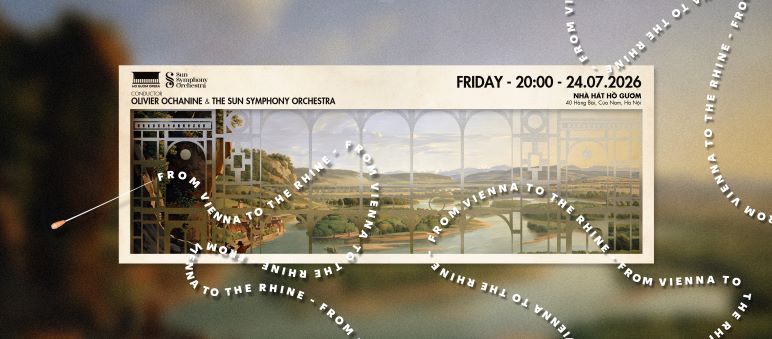
From Schubert's graceful lyricism to Schumann's majestic portrait of the Rhine, this program unfolds an evocative journey through the heart of German Romanticism. Each work captures a different facet of youth, nature, and the boundless spirit of artistic aspiration.
Franz Schubert (1797–1828)
Overture to Die Zauberharfe, D. 644
Franz Schubert (1797–1828)
Symphony No. 2 in B-flat major, D. 125
-Intermission-
Robert Schumann (1810–1856)
Symphony No. 3 in E-flat major, Op. 97, “Rhenish”
Overture to Die Zauberharfe (The Magic Harp) (“Rosamunde Overture”)
Franz Schubert (1797–1828)
Few composers possessed a gift for melody as effortless and natural as Franz Schubert. Although best known today for his songs, chamber music, and symphonies, he also composed for the theatre throughout his short life. One of these projects was Die Zauberharfe (“The Magic Harp”), an 1820 melodrama that enjoyed little success and soon disappeared from the stage. Yet from this forgotten work emerged one of Schubert’s finest orchestral overtures.
Ironically, the overture achieved fame not through Die Zauberharfe itself, but because it was later reused as the introduction to the incidental music for Rosamunde. For many years it was mistakenly known as the “Rosamunde Overture,” and it is today often still known as the Rosamunde Overture.
The music begins with a noble, mysterious introduction before bursting into a sparkling Allegro filled with buoyant rhythms and radiant lyricism. Already evident are many hallmarks of Schubert’s mature style: graceful melodies that seem to unfold without effort, luminous orchestral colours, and a remarkable balance between Classical elegance and Romantic warmth.
Although lasting only around ten minutes, the overture perfectly sets the tone for this evening’s journey. It opens the door to a world where lyric beauty, youthful optimism, and dramatic imagination coexist—a fitting invitation to travel from the musical heart of Vienna toward the rich landscapes of the Rhine.
Symphony No. 2 in B-flat major, D.125
Franz Schubert
When Schubert completed his Second Symphony in 1815, he was just seventeen years old. Astonishingly, this extraordinarily productive year also saw the composition of more than 140 songs, several masses, chamber works, and another symphony. Although still a teenager, Schubert already displayed a remarkably individual musical voice.
The influence of Joseph Haydn and Wolfgang Amadeus Mozart is unmistakable. The symphony embraces the Classical ideals of clarity, balance, and elegance while hinting at the expansive lyricism that would become Schubert’s hallmark. Unlike Ludwig van Beethoven, whose symphonies increasingly pursued dramatic conflict, Schubert often preferred to allow melody itself to guide the musical narrative.
A grand slow introduction gives way to an energetic Allegro alive with youthful exuberance. Throughout the movement, Schubert delights in surprising harmonic turns and graceful exchanges between orchestral sections.
The Andante offers one of the composer’s earliest demonstrations of his extraordinary melodic gift. Singing lines flow naturally across transparent orchestral textures, creating music of serenity and gentle optimism.
Instead of the expected graceful minuet, Schubert writes a movement full of rhythmic energy and robust humour, revealing his growing confidence as a symphonist.
The lively finale bubbles with wit and vitality. Brilliant woodwind writing, sparkling rhythms, and playful thematic development bring the symphony to an exhilarating conclusion, already suggesting the imagination that would later produce the “Unfinished” Symphony and the monumental “Great” C major Symphony.
Though rarely performed compared with Schubert’s later orchestral works, the Second Symphony is a remarkable achievement—music that captures the freshness of youth while foreshadowing the lyrical genius that would soon transform the Romantic symphony.
Symphony No. 3 in E-flat major, Op. 97 (Rhenish)
Robert Schumann (1810–1856)
Composed in 1850, Schumann’s Third Symphony reflects one of the happiest periods of his life. Having recently accepted the position of Music Director in Düsseldorf, Schumann found himself inspired by the landscapes, traditions, and vibrant cultural life of the Rhineland. The result was the “Rhenish” Symphony, a work overflowing with warmth, optimism, and life.
Unlike the traditional four-movement symphony, Schumann expanded the work into five movements, allowing each to capture a different facet of the Rhine region.
The opening movement bursts forth with confidence. Its broad, heroic themes evoke the majesty of the Rhine River and the expansive spirit of the surrounding landscape. Rather than presenting dramatic struggle, Schumann celebrates movement, vitality, and joy.
The second movement resembles a rustic dance, inspired by the folk traditions of the Rhineland. Gentle ländler rhythms and warm orchestral colours paint scenes of village festivities and life along the riverbanks.
A lyrical third movement provides a moment of repose. Graceful melodies and delicate orchestration create an atmosphere of quiet reflection before the symphony’s emotional centre.
The solemn fourth movement is among Schumann’s most original inspirations. During a visit to Cologne Cathedral, Schumann witnessed the ceremonial elevation of an archbishop to the rank of cardinal. Deep brass sonorities, chorale-like writing, and rich contrapuntal textures evoke the grandeur and spiritual majesty of the Gothic cathedral. The movement is not intended as liturgical music but as an expression of awe and reverence.
Without pause, the finale dispels the previous movement’s solemnity. Joyful themes return, and the symphony concludes with exuberance and confidence. If the fourth movement contemplates the spiritual grandeur of the Rhineland, the finale celebrates its people—their resilience, generosity, and zest for life.
Together, these three works trace a remarkable musical journey. Schubert’s youthful brilliance represents the flowering of Viennese Classicism into early Romanticism, while Schumann’s “Rhenish” Symphony carries that tradition westward, embracing richer orchestral colours, broader emotional horizons, and the emerging spirit of the High Romantic era. From Vienna to the Rhine, this programme follows not only a geographical path but also the evolution of German-speaking orchestral music during one of its most fertile creative periods.