Short description
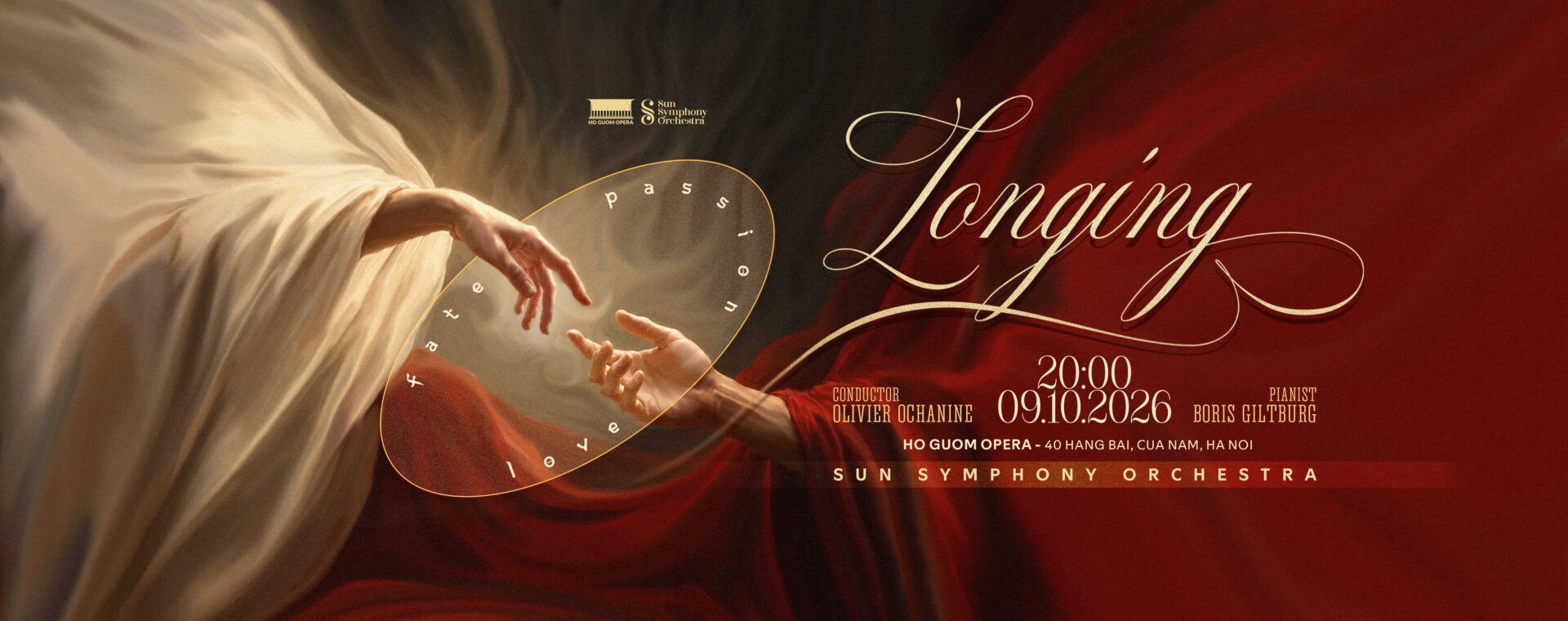
A musical journey through memory, longing and love.
Thiên Cổ Tình – LONGING: A musical exploration from the longing for Hanoi to the tragic love of Russian music. An emotion-filled evening of yearning, separation, and the things that remain forever beyond reach, through works by Hoàng Dương, Trịnh Công Sơn, Rachmaninoff, and Prokofiev.
Hoàng Dương (1925–2018)
Hướng về Hà Nội, arr. Trần Mạnh Hùng, cello solo
Trịnh Công Sơn (1939–2001)
Nhớ mùa thu Hà Nội, arr. Trần Mạnh Hùng
Sergei Rachmaninoff (1873–1943)
Piano Concerto No. 2, Boris Giltburg, piano
Sergei Prokofiev (1891–1953)
Excerpts from Romeo and Juliet
Longing……..
Tonight’s program begins with two Vietnamese songs that hold Hà Nội in memory: one as a city to which the heart turns, the other as an autumn landscape of old streets, familiar scents and quiet reflection. From there, longing takes different forms: the yearning lyricism of Rachmaninoff’s concerto and the urgent, youthful love of Shakespeare’s Verona. Across music from Vietnam and Europe, private feeling meets the places and people that shape it.
Hoàng Dương: Hướng về Hà Nội
For cello and orchestra; cello soloist: Phúc Phan
The title means “Toward Hà Nội” or “Longing for Hà Nội.” Hoàng Dương’s song looks toward the city from a distance, its gently unfolding melody carrying both tenderness and homesickness. In this instrumental arrangement, the cello takes the role of the human voice. Its warm, expressive line gives the song’s yearning a personal quality—as if remembering a beloved city in a moment of quiet solitude.
Trịnh Công Sơn: Nhớ mùa thu Hà Nội
“Remembering an Autumn in Hà Nội”; arranged by Trần Mạnh Hùng
Trịnh Công Sơn’s song conjures Hà Nội through the details of autumn: golden leaves, old tiled roofs, the scent of hoa sữa and the still waters of West Lake. These images gather into something larger than a portrait of the city. The song’s speaker moves among familiar streets and wonders what, or whom, they miss. Here, memory becomes a way of belonging: to a place, to its people, and to a feeling that remains even when the moment has passed.
Sergei Rachmaninoff: Piano Concerto No. 2 in C minor, Op. 18
Piano soloist: Boris Giltburg
Rachmaninoff’s Second Piano Concerto emerged from a difficult period in the composer’s life, following the poor reception of his First Symphony. Composed mainly in 1900–01, the concerto marked a return to creative confidence. Its first complete performance took place in Moscow in 1901, with Rachmaninoff at the piano; he dedicated the published work to the physician Nikolai Dahl, who had supported him during this period.
The concerto begins with the piano alone: a sequence of deep, tolling chords that gradually gathers force before the orchestra enters with the first great melody. Throughout the work, piano and orchestra share the expressive weight. The piano dazzles with surging runs and rich textures, while the orchestra carries melodies of expansive, almost vocal character.
The central Adagio sostenuto offers a more intimate sound world. A clarinet introduces one of Rachmaninoff’s most cherished melodies, which the piano takes up and unfolds in a long, searching arc. The finale brings renewed momentum, culminating in a broad, radiant tune that gathers the concerto’s tension and yearning into a powerful close.
Written in the late-Romantic tradition, the concerto moves between brooding intensity and open-hearted lyricism. Its music seems to reach beyond itself—toward a voice, a memory, or a place just out of reach.
Sergei Prokofiev: Excerpts from Romeo and Juliet, Op. 64
Prokofiev’s ballet brings Shakespeare’s tragedy to life through sharply drawn musical characters and vivid contrasts. Its world is full of restless energy: street scenes and dances give way to the private tenderness of the young lovers, while the feud between the Montagues and Capulets casts a shadow over every celebration.
The excerpts move through sharply different sides of the story. Juliet’s music catches her as both a playful, spirited girl and someone beginning to discover the depth of her feelings. The meeting of Romeo and Juliet brings a more intimate lyricism, while Masks turns the Capulets’ ball into a scene of mounting unease. In Friar Lawrence, the music takes on a quieter, more reflective character; in Death of Tybalt, turbulent motion and forceful orchestral writing propel the drama toward violence.
Prokofiev’s score is remarkable for the way its melodies can be both immediately memorable and emotionally complex. A dance may sound buoyant on the surface while the family conflict remains just beneath it. Sudden changes in rhythm, harmony and orchestral color make the music feel theatrical even without dancers: we hear the bustling city, the lovers’ sheltered world, and the danger closing in around them.
The closing tragedy depends on a cruel misunderstanding. Juliet takes a potion that makes her appear dead, and Romeo reaches her tomb before she awakens. The funeral music therefore accompanies a deathlike sleep; believing Juliet is truly gone, Romeo takes poison, and only then does she wake to find him dead. Prokofiev makes the sequence especially affecting by setting the ceremony of mourning against the terrible reality still to come.
Prokofiev composed most of the ballet in 1935, but production delays led him to shape concert suites from its music before the ballet reached the stage. The excerpts heard tonight are drawn from across the score and arranged as a concert journey through its shifting moods—youthful play, attraction, conflict and loss.