Short description
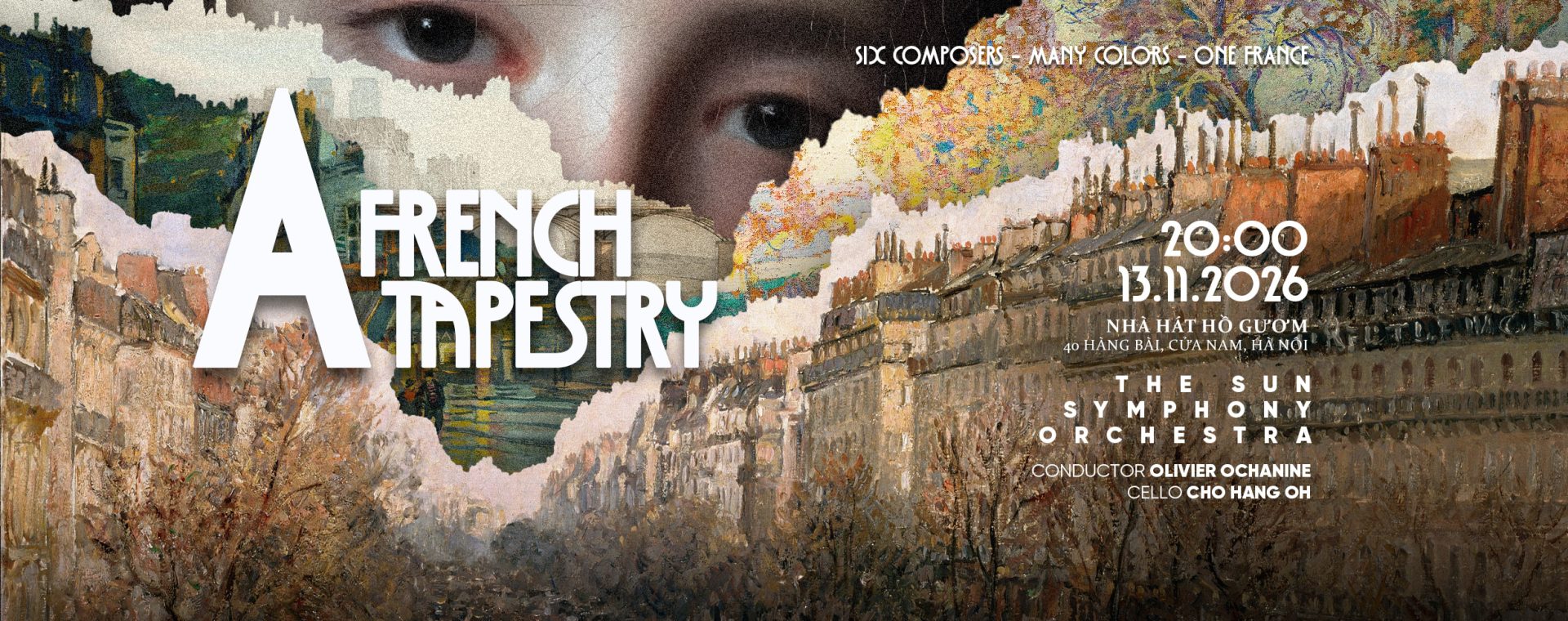
In France, music and the visual arts have long gone hand in hand: elegance leaves room for irreverence, and even the simplest melody can reveal extraordinary imagination. Spanning the late nineteenth and twentieth centuries, A French Tapestry brings together six composers, each contributing a distinctive thread, from the refined lyricism of Gabriel Fauré to the sparkling theatricality of Georges Bizet. Together, they weave a tapestry of French charm, wit, and poetry.
GABRIEL FAURÉ (1845–1924)
Masques et bergamasques, Op. 112 – Suite
VINCENT D’INDY (1851–1931)
Lied for Cello and Orchestra, Op. 19
FRANCIS POULENC (1899–1963)
Suite française
-Intermission-
JEAN FRANÇAIX (1912–1997)
Ouverture anacréontique
CLAUDE DEBUSSY (1862–1918)
Petite Suite
GEORGES BIZET (1838–1875)
Jeux d’enfants, Op. 22 — Orchestral Suite
Ticket prices: 300,000 VND | 500,000 VND | 800,000 VND | 1,000,000 VND | 2,000,000 VND
Ticket hotline: 0965 765 946 | 0913 489 858 (free ticket delivery)
Seating chart and tickets: https://forms.gle/moRF2jcDurzmVyo67
Gabriel Fauré (1845–1924)
Masques et bergamasques, Op. 112 — Suite
Composed in 1919, Masques et bergamasques draws its inspiration from the elegant world of eighteenth-century French entertainment, with its masked festivities, graceful dances, and playful theatrical traditions. Although written near the end of Fauré’s life, the music possesses a youthful freshness and lightness of spirit.
The suite’s four movements — Ouverture, Menuet, Gavotte, and Pastorale — reveal Fauré’s gift for refined orchestral writing. Rather than relying on grand gestures, he creates an atmosphere of effortless charm through delicate textures, graceful rhythms, and subtly shifting harmonies.
Beneath the music’s apparent simplicity lies the unmistakable sophistication of a composer whose influence helped shape modern French music. The result is a delightful opening to tonight’s celebration of French musical artistry.
⸻
Vincent d’Indy (1851–1931)
Lied for Cello and Orchestra, Op. 19
Vincent d’Indy occupies a distinctive place in French musical history. A devoted admirer of César Franck and a passionate advocate for musical craftsmanship, he combined the structural discipline of the German Romantic tradition with a distinctly French sensitivity to color and expression.
His Lied for cello and orchestra is an intimate and lyrical work in which the solo instrument takes on the character of a human voice. The title, borrowed from the German word for song, reflects the music’s deeply expressive nature. Rather than emphasizing virtuosity for its own sake, d’Indy allows the cello to unfold long, singing phrases against a gently supportive orchestral accompaniment.
Tonight’s performance also marks a special occasion for the Sun Symphony Orchestra as we welcome Cho Hang Oh, our incoming Principal Cellist, as the featured soloist. We are delighted to introduce him to our audience in a work that beautifully showcases the cello’s warmth, expressive range, and lyrical character.
⸻
Francis Poulenc (1899–1963)
Suite française
Few composers capture the contradictions of French musical character quite as vividly as Francis Poulenc. His music can be mischievous one moment and profoundly sincere the next, combining irreverent humor with elegance and emotional directness.
Written in 1935 for a theatrical production, the Suite française takes its inspiration from the Renaissance dances of Claude Gervaise. Poulenc reimagines these centuries-old melodies through his unmistakably twentieth-century musical language, preserving their rhythmic vitality while introducing fresh harmonies and colorful instrumental combinations.
Across seven short movements, the suite moves between ceremonial grandeur, rustic energy, gentle melancholy, and playful exuberance. Poulenc’s particular genius lies in making the unexpected sound entirely natural, creating music that feels simultaneously ancient and modern.
⸻
Jean Françaix (1912–1997)
Ouverture anacréontique
Jean Françaix was one of the twentieth century’s most accomplished musical humorists. A brilliant pianist and exceptionally gifted composer, he cultivated a style characterized by clarity, elegance, rhythmic precision, and an almost inexhaustible sense of wit.
His Ouverture anacréontique, composed in 1978, takes its name from Anacreon, the ancient Greek poet associated with wine, love, and the pleasures of life. True to that spirit, the overture is full of vitality, playful gestures, and sparkling orchestral invention.
Françaix delights in sudden changes of character, unexpected instrumental combinations, and quicksilver musical exchanges. Beneath its apparent lightheartedness lies extraordinary compositional skill: every detail is precisely calculated, yet the music unfolds with irresistible spontaneity.
The result is a brilliant orchestral entertainment that reminds us that sophistication and humor need never be opposites.
⸻
Claude Debussy (1862–1918)
Petite Suite
Originally composed in 1889 for piano four hands, Debussy’s Petite Suite was later orchestrated by his colleague Henri Büsser, transforming its delicate keyboard textures into a luminous orchestral landscape.
The work’s four movements — En bateau, Cortège, Menuet, and Ballet — evoke a world of gentle movement, graceful ceremony, and elegant dance. The opening movement, En bateau (“In a Boat”), suggests the peaceful motion of water, while the remaining movements explore contrasting shades of charm, nostalgia, and rhythmic vitality.
Although written before Debussy developed the revolutionary musical language of his later masterpieces, the suite already reveals his extraordinary sensitivity to atmosphere and instrumental color. Melodies seem to float effortlessly, harmonies shimmer, and familiar dance forms acquire a subtle sense of mystery.
Petite Suite offers a glimpse into the imagination of a composer who would fundamentally transform the sound of modern music.
⸻
Georges Bizet (1838–1875)
Jeux d’enfants, Op. 22 — Orchestral Suite
Best known for his opera Carmen, Georges Bizet possessed an exceptional gift for melody, orchestral brilliance, and theatrical characterization. These qualities are equally apparent in Jeux d’enfants (“Children’s Games”), a collection of musical miniatures inspired by the imaginative world of childhood.
Originally written in 1871 as twelve pieces for piano four hands, Bizet subsequently orchestrated five of them to create a sparkling orchestral suite.
Each movement depicts a different childhood game or activity, from the graceful motion of a spinning top to the playful energy of a game of leapfrog. Bizet captures these scenes with remarkable vividness, using rhythmic invention, colorful orchestration, and melodies of irresistible charm.
Yet the music is far more than a collection of charming illustrations. Its precision, elegance, and imagination reveal a composer capable of transforming the simplest subjects into miniature orchestral masterpieces.
With its joyful energy and brilliant conclusion, Jeux d’enfants brings tonight’s French musical journey to a spirited and celebratory close.
Together, these six works reveal a musical tradition of extraordinary richness. Whether through Fauré’s refinement, d’Indy’s lyricism, Poulenc’s wit, Françaix’s exuberance, Debussy’s shimmering colors, or Bizet’s playful imagination, each composer offers a unique perspective on the expressive possibilities of the orchestra.