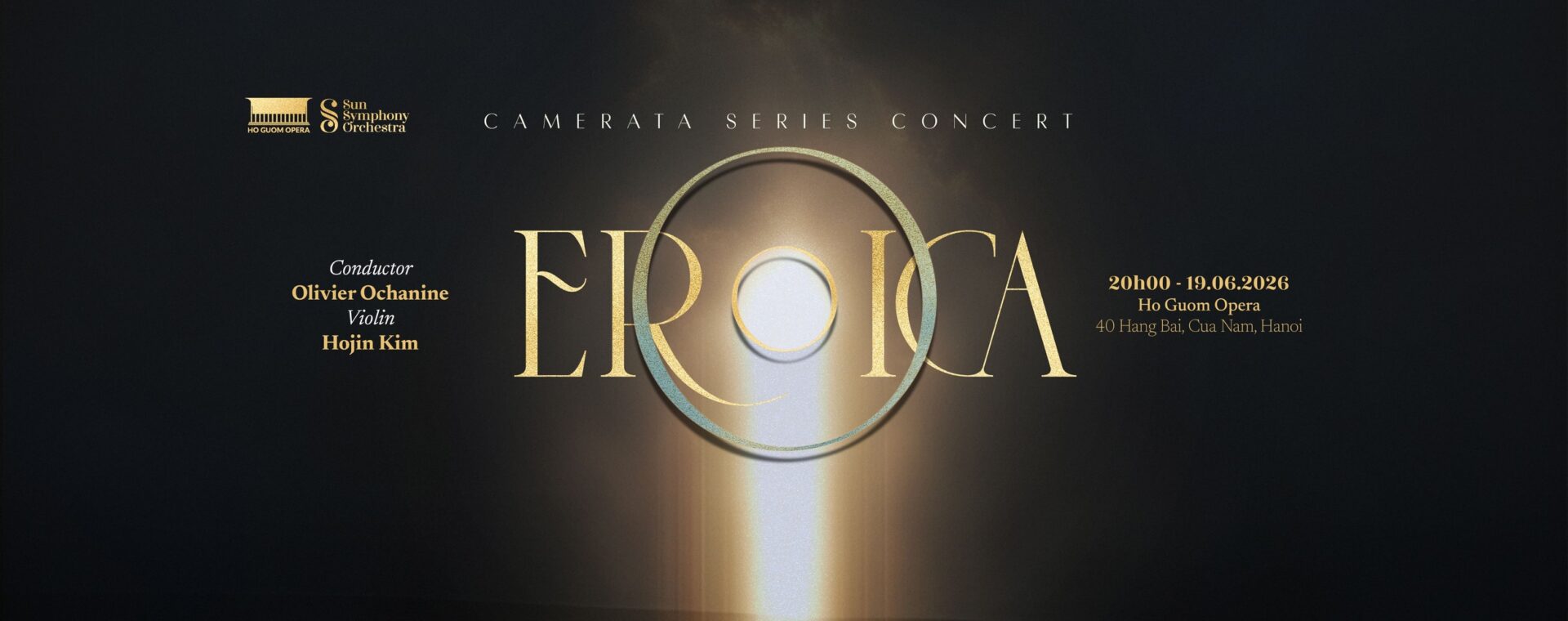
Short description
The programme traces a compelling musical journey from the Nordic imagination of Sibelius - rich with mystery, lyricism, and expressive string writing — to the monumental force of Beethoven’s Eroica. Moving from intimate color to symphonic heroism, the evening promises both refinement and grandeur, ending with one of the most transformative works in the orchestral repertoire.
Jean Sibelius (1865 – 1957)
Suite from “Belshazzar’s Feast” Op. 51
Humoresque 5 for Violin & Orchestra
Violin: Hojin Kim
Impromptu for Strings, Op. 5
—-
Ludwig van Beethoven (1770 – 1827)
Symphony No. 3 in E-flat Major, Op. 55 “Eroica”
Jean Sibelius (1865–1957)
Suite from Belshazzar’s Feast, Op. 51 (1906)
Although Jean Sibelius is often associated with the vast forests, lakes, and legends of his native Finland, Belshazzar’s Feast reveals a different side of the composer. Written as incidental music for a play by the Finnish author Hjalmar Procopé, the score transports listeners far from the Nordic landscape to the ancient world of Babylon.
The biblical story of King Belshazzar culminates in the famous “writing on the wall,” foretelling the ruler’s downfall. Yet Sibelius’s suite focuses less on drama and more on atmosphere. Richly colored orchestration and modal melodies evoke an exotic and distant world.
The four movements unfold as a sequence of vivid scenes. Orientale opens with a sense of mystery and wonder, while Solitude offers a moment of introspective lyricism. The dreamy Nocturne is among Sibelius’s most enchanting miniatures, and the lively Khadra’s Dance brings the suite to an exuberant conclusion.
Though modest in scale, Belshazzar’s Feast demonstrates Sibelius’s extraordinary ability to create entire worlds with remarkable economy of means.
⸻
Jean Sibelius
Humoresque No. 5 in E-flat major, Op. 89
for Violin and Orchestra
Between 1917 and 1918, Sibelius composed a set of six Humoresques for violin and orchestra. Unlike the grand symphonic statements for which he is best known, these works inhabit a more intimate and personal sphere.
The Fifth Humoresque is among the most charming of the set. Light-footed and elegant, it combines virtuoso brilliance with an unmistakable Nordic lyricism. The solo violin dances effortlessly above a transparent orchestral accompaniment, displaying both technical agility and expressive warmth.
The title “Humoresque” should not be taken literally as humorous. Rather, it refers to a capricious and free-spirited character. In this miniature gem, Sibelius creates music that is playful yet refined, offering a delightful contrast to the larger canvases that surround it.
⸻
Jean Sibelius
Impromptu for Strings, Op. 5
Composed in 1893, the Impromptu for Strings belongs to Sibelius’s early creative period, when he was still forging the musical language that would later define his mature style.
The work unfolds as a single lyrical meditation for string orchestra. Its warm sonorities and flowing melodies reveal the influence of the Romantic tradition, while hints of the composer’s distinctive voice are already evident in its spacious phrasing and subtle harmonic turns.
Though rarely performed, the Impromptu possesses a quiet beauty that makes it one of Sibelius’s most appealing shorter works. It serves as a bridge between the youthful composer and the symphonic master he would become.
⸻
Ludwig van Beethoven (1770–1827)
Symphony No. 3 in E-flat major, Op. 55, Eroica
When Beethoven completed his Third Symphony in 1804, the history of music changed forever.
The symphony was originally dedicated to Napoleon Bonaparte, whom Beethoven admired as a champion of republican ideals. According to the composer’s student Ferdinand Ries, Beethoven furiously tore the dedication page in half when Napoleon declared himself Emperor. The work was eventually published under the title Sinfonia Eroica—“Heroic Symphony”—composed, as Beethoven wrote, “to celebrate the memory of a great man.”
Yet the true hero of the symphony is not a single individual. Rather, it is the human spirit itself.
From its opening two hammer-blow chords, the Eroica announces a new musical world. The first movement expands symphonic form to an unprecedented scale, combining dramatic conflict with extraordinary inventiveness. The second movement, a solemn Funeral March, explores grief and loss with profound emotional depth. A vigorous Scherzo follows, bursting with energy and life, before the Finale transforms a simple theme into a dazzling series of variations that culminate in triumph.
The Eroica shattered expectations of what a symphony could be. It is longer, more ambitious, and more emotionally expansive than anything that had come before. In doing so, it opened the door to the Romantic era and established Beethoven as one of music’s great revolutionaries.
More than two centuries later, the Third Symphony remains a work of astonishing power—a monument to courage, struggle, and ultimately, victory.