Short description
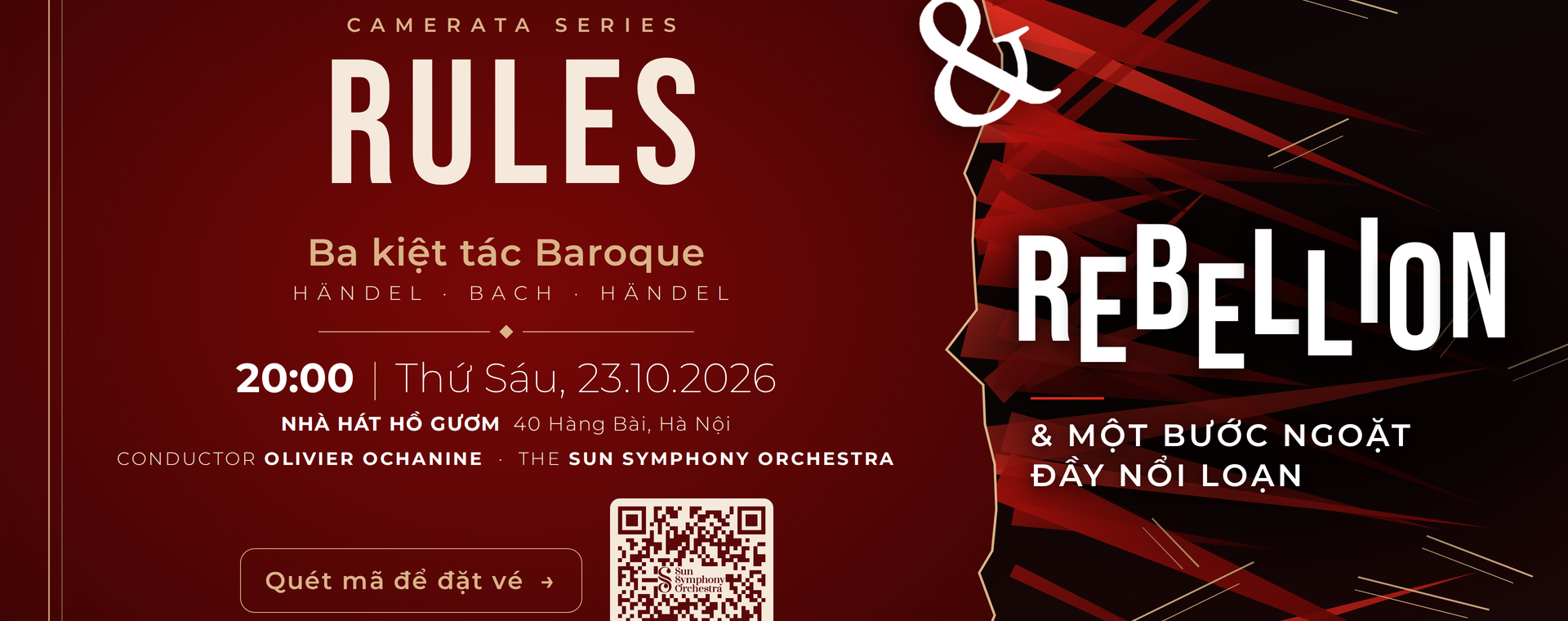
Every musical performance depends on rules. Rhythm organizes time; notation tells musicians what to play; harmony creates expectations; and an ensemble relies on individuals agreeing to act together. But composers have always tested those rules—working within them, stretching them, and sometimes deliberately breaking them.
Rules & Rebellion travels across nearly three centuries to explore that tension.
Handel and Bach inherited an elaborate musical language governed by convention: established dances, ceremonial forms, counterpoint and hierarchy. Yet within those boundaries they created music of extraordinary imagination and individuality. By the twentieth century, Louis Andriessen would challenge the institution of the orchestra itself. In Workers Union, conventional pitches disappear and individual musicians gain remarkable freedom—but they remain bound by some of the strictest rhythmic discipline imaginable.
The journey therefore isn't simply from rules to rebellion. It asks a more interesting question: can rebellion exist without rules at all?
George Frideric Händel
Water Music — Suite No. 2 in D major, HWV 349
Johann Sebastian Bach
Orchestral Suite No. 2 in B minor, BWV 1067
-Intermission-
George Frideric Händel
Music for the Royal Fireworks, HWV 351
Louis Andriessen
Workers Union
George Frideric Hädel
Water Music — Suite No. 2 in D major, HWV 349
The story begins with music created for one of the most rule-bound environments imaginable: a royal court.
Handel’s Water Music accompanied King George I on a journey along the River Thames on 17 July 1717. The king travelled aboard a royal barge while musicians followed on another vessel, their music carrying across the water. Contemporary reports suggest that the king was so delighted that portions of the music were repeated several times.
The Second Suite is dominated by the brilliant sounds of horns and trumpets. Its movements draw upon established eighteenth-century forms and dances, and its ceremonial character reflects the social hierarchy for which it was created.
Yet Handel’s personality continually escapes the confines of ceremony. Rhythms leap forward, horns call to one another across the orchestra, and courtly gestures become exuberant public entertainment.
Here, the rules are not restrictions. They are the framework within which Handel plays.
Johann Sebastian Bach
Orchestral Suite No. 2 in B minor, BWV 1067
If Handel demonstrates freedom within ceremonial convention, Bach reveals what can happen when rules are pursued with almost unimaginable sophistication.
The Second Orchestral Suite is constructed around forms inherited largely from French courtly dance. After its imposing opening Ouverture comes a succession of Rondeau, Sarabande, Bourrées, Polonaise and Menuet. Each carries conventions of rhythm, character and proportion that Bach’s listeners would have recognized.
But Bach never simply follows a template.
The solo flute constantly shifts identity: sometimes integrated into the ensemble, sometimes floating above it, sometimes engaged in intricate conversation with the strings. Dance rhythms become vehicles for counterpoint and invention.
Finally comes the famous Badinerie—its title suggesting playfulness or jesting. After the elegance and discipline of everything preceding it, the flute suddenly seems almost to rebel against restraint, racing through a brilliant display of virtuosity.
The rules remain intact. Bach simply demonstrates how much freedom can exist inside them.
George Frideric Händel
Music for the Royal Fireworks, HWV 351
By 1749, Handel was again writing music for royalty—but this time on an enormous scale.
Music for the Royal Fireworks celebrated the Treaty of Aix-la-Chapelle and the end of the War of the Austrian Succession. King George II requested an outdoor spectacle dominated by what were described as “warlike instruments,” and Handel responded with music conceived for huge forces of winds, brass and percussion.
The work itself is filled with order and symbolism. A monumental French overture establishes ceremonial authority. La Paix represents peace; La Réjouissance celebrates rejoicing. Music, politics and public spectacle were carefully choreographed into a demonstration of royal power.
Reality proved less obedient.
The public rehearsal attracted enormous crowds. On the night of the celebration, bad weather complicated the festivities, the fireworks malfunctioned, and part of the elaborate pavilion constructed for the occasion caught fire.
It is an almost perfect episode for Rules & Rebellion: an event designed down to the smallest detail as a display of order and control, overtaken by unpredictability and chaos.
Handel’s music survived the spectacle that inspired it. Its blazing trumpets, horns and rhythms still possess the power of a celebration that seems perpetually on the verge of breaking free.
Louis Andriessen
Workers Union
Then the rules change.
Composed in 1975, Louis Andriessen’s Workers Union challenges some of the most fundamental assumptions of Western orchestral music.
It is written for “any loud-sounding group of instruments.” More radically, Andriessen does not prescribe conventional pitches. Musicians see rhythms and contours indicating whether their lines should move higher or lower, but the precise notes are left to the performers.
The traditional hierarchy begins to disappear.
There is no conventional orchestration. No fixed harmony. No definitive collection of pitches. Performers possess freedoms that Bach or Handel could scarcely have imagined.
But this is not musical anarchy.
The rhythmic notation is brutally precise. Repeated patterns must remain coordinated as accents shift, textures accumulate and the physical intensity increases. Individual players can choose certain aspects of what they play, but the ensemble succeeds only through collective discipline.
Andriessen described the work as combining “individual freedom and severe discipline.”
That idea provides the key to the entire concert.
In Handel and Bach, musicians inhabit carefully established systems and discover freedom within them. Andriessen overturns many of those systems—but immediately creates new ones. His performers are liberated from fixed pitches only to become bound together by rhythm.
The title Workers Union reinforces the paradox. Every musician remains an individual, yet power comes from coordinated collective action. As the piece builds, the ensemble begins to resemble a vast machine powered by human beings: repetitive, physical, relentless and increasingly exhilarating.
Nearly three centuries separate Handel’s royal barges from Andriessen’s musical workers. The institutions, sounds and assumptions have radically changed.
But one question remains:
How far can we break the rules before we need to create new ones?